Boys Bedroom Sets

Boys Bedroom Sets

childrens bedroom with red airplane

Credit: Philip Harvey

Create a bright and happy bedroom for the young man in your life. Find inspiring decor and boy's bedroom ideas from some of our favorite spaces that are all boy.

1 of 19

Cheery Space to Play

childrens bedroom with white green and blue décor

Credit: Edmund Barr

Kid spaces are a great opportunity to add multiple layers of color, but resist the urge to go overboard with too many saturated tones. Take color cues from a pillow or cheerful striped rug that layer several muted shades together but do not overwhelm with too many competing colors of the rainbow. This boy's room decor features calming shades of blue, gray, and white, with small doses of bright green added for fun.

Advertisement

Advertisement

2 of 19

Organizing Made Easy

childrens bedroom with bunk bed and blue shelving

Credit: James Nathan Schroder

Teach your little one the ins and outs of organization with clear boy's bedroom storage. What was once a bookshelf became home to this little boy's toys, keepsakes, and games. With clearly defined places for everything, your little boy will be more likely to want to clean up on his own after playtime.

3 of 19

Stripes Galore

childrens bedroom bunk beds and primary colors

Credit: Kimberly Gavin

There's something about stripes that just seems to scream "boy's room." This boy's bedroom design goes all out with stripes of different sizes and colors, but the underlying scheme of blue, yellow, and white ties the whole space together. Primary colors are always a good bet for kids' rooms and can be adjusted to fit a more mature bedroom in a boy's future.

Advertisement

4 of 19

Boy's Bedroom Ideas

Color and pattern can do a lot when it comes to bedroom decor. Smart (and decorative) storage solutions play double duty in this boy's bedroom design. See how simple decorating ideas add personality and how you can do the same in your little guy's room.

5 of 19

The Chameleon of Color

childrens bedroom white walls and colorful decor

Credit: Ed Gohlich

White walls look anything but boring when paired with a bold patterned bedspread and bright boy's bedroom decor. Sunny orange, bright blue, and lime green accents create a lively color scheme. Crisp white bedroom walls and open shelves set a neutral backdrop that will pair perfectly with any decorating style as tastes change.

6 of 19

Out to Sea

nautical themed childrens bedroom

Credit: John Bessler

This nautical shared bedroom uses boat-shaped boy's bedroom furniture to emphasize the theme. Complementary wall art and a red, white, and navy scheme gives the bedroom a cohesive and masculine look. White walls help balance the rich red carpet.

Advertisement

Advertisement

7 of 19

The New Neutral

childrens bedroom with stuffed animals

Credit: David A Land

Although many people don't think of blue as a neutral, it really is one of those colors that goes with just about everything. Soft blue walls blend effortlessly with a variety of patterns and textures in this toddler boy's nursery. Plus these soothing shades of blue will have true staying power as he grows. When considering boy's bedroom ideas for small rooms, turn to light blue as its airy shade makes a space look bigger.

8 of 19

Sports, Sports, Sports

childrens bedroom with basketball artwork

Credit: Reed Davis

Drive home a sports theme for an active boy's bedroom without going overboard with astroturf and sports-inspired bedding. This boy's room uses a large basketball print with vivid color to set the color scheme. Floating shelves feature the trophies and awards he's most proud of.

9 of 19

Nautical Preppy

childrens bedroom white walls and nautical decor

Credit: Laura Moss

Give a boy's room a nautical vibe with a navy boy's bedroom set, plank walls, and ship-inspired accessories. A gallery wall of antique posters and sailboat flag bunting adds to the theme without making the decor look too juvenile. A madras quilt at the foot of the bed brings all the accent colors together.

Advertisement

10 of 19

Space Cadet

childrens bedroom with planets and stuffed animals

Credit: Alise O'Brien

Wondering how to decorate when your little one adores outerspace? Instead of embracing an all-out cosmic boy's bedroom theme, use neutral colors and furniture to create a sophisticated space, then add fun planet-theme accessories. A large model solar system hanging above the bed is fun now but can be easily replaced as interests change.

11 of 19

Room for Two

thin white floor-to-ceiling vertical cabinet

Credit: Jay Wilde

Although shared spaces are fun, it's important to choose a theme that everyone likes. The masculine color scheme in this boy's bedroom allows for many possibilities in wall hangings and accessories. Mature bedding and upholstered headboards can last well into these brothers' teen years.

12 of 19

Artsy Inspiration

childrens bedroom with square shelving

Credit: Greg Scheidemann

Searching for a kid-friendly color scheme? Look no further than their artwork! Inspiration for this boy's room came from the dynamic painting hanging on the wall. Blue walls look great contrasted with a vibrant orange bookshelf and throw blanket, and a few splashes of lime make for a fun color scheme.

Advertisement

13 of 19

Explorer Extras

childrens bedroom with painted maps

Credit: Susan Gilmore

Consider defining an oddly shaped room with a high-contrast paint job or accent wall. This built-in bed nook features a map mural that coordinates with the washy blue walls of the rest of the room. Not only does this boy's bedroom paint idea emphasize the layout, it also gives the room an adventurous theme.

14 of 19

Forest Fun

childrens bedroom with blue and orange bedding

Credit: Edmund Barr

Nature-inspired boy's bedroom ideas are great for any little boy with a love for the outdoors. To emphasize a vaulted ceiling, this boy's bedroom features white shiplap that runs vertically on the wall and horizontally on the ceiling. A mix of natural materials, like twine on the bed frame, bamboo Roman shades, and a wood accent wall, add to the woodland feel.

15 of 19

Storage for All

childrens bedroom with white shelving

Credit: Michael Partenio

Cleaning up after playtime will be a snap with built-in boy's bedroom storage. Colorful bins and baskets hold art supplies, playing cards, paper, and more. The lower shelves are great for storing kid-friendly books, toys, and games, while the top shelves are better for items that need parental supervision.

Advertisement

16 of 19

Fun for All Ages

childrens bedroom with couch and bunk bed

Credit: John Merkl

Gray continues to be a popular neutral and works for both younger boys and teenagers. Shades of gray, black, and brown create this neutral boy's bedroom. Add pops of blue in seating, accent pillows, or wall art for a fresh dose of relaxing color.

17 of 19

Creative Beds

childrens bedroom with drum set

Credit: Alec Hemer

To give your boys more room for both work and play, consider pushing their beds along adjacent walls. The open space in the middle of the room will be perfect for overnight guests or playtime. Consider lofted beds for your boy's bedroom; the space below works as a fort when they're young and a place for storage or study as they grow older.

18 of 19

Monkeying Around

childrens bedroom with oar and stuffed animals

Credit: Reed Davis

A jungle theme gets a nautical twist in this gorgeous neutral bedroom. Classic sock monkeys swing from vines, while others perch happily on vintage boat oars. A twin-size bed packs extra storage with built-in drawers for toys and clothing. A shag rug adds comfort and style underfoot.

Advertisement

19 of 19

Happy Campers

childrens bedroom with red airplane

Credit: Philip Harvey

Wondering what to do when your little one adores flying? Instead of embracing an all-out aviation theme, use neutral colors and furniture to create a sophisticated space and add fun airplane-theme accessories. A large model airplane hanging above the bed and some adorable airplane throw pillows embrace his love of flying, but the items can be easily replaced as his interests change.

Up Next

Boys Bedroom Sets

Source: https://www.bhg.com/rooms/kids-rooms/boys/bedrooms-just-for-boys/
Share:

8 X 12 Bedroom Layout

8 X 12 Bedroom Layout

If you've got a medium to large sized room, chances are that you've got a queen size bed. The dimensions of this bed are 5' x 6'-6" (152 × 202cm). But a simple bed does not make a good bedroom – it's all the accent pieces and accompanying furniture that makes the space worth living in.

In case of a bedroom, the area rug caps off the whole interior design. It may feel like a bonus accessory, but notice a bedroom with and without an area rug and you'll immediately see the difference. So now, the real question is:

What Size Area Rug Under a Queen Bed?

A 4'x6' rug pairs well with a queen and Olympic queen sized bed, but only if your bedroom is small. If you're working with a medium or large sized room, then the ideal rug size should be at least 8 feet in length.

This is because the 6' (72") length of a 4'x6' rug only extends a few inches on either side of the footboard compared to the larger span of a 5'x8' or 6'x9' rug.

A standard queen bed is 60 inches wide by 80 inches long, whereas an Olympic queen bed – a non-standard option – is 66 inches wide.

The following factors need to be considered when selecting the perfect area rug size for your queen bed:

The size of your room

The size of your rug mostly depends on the size of the room. Both must complement and correspond with each other.

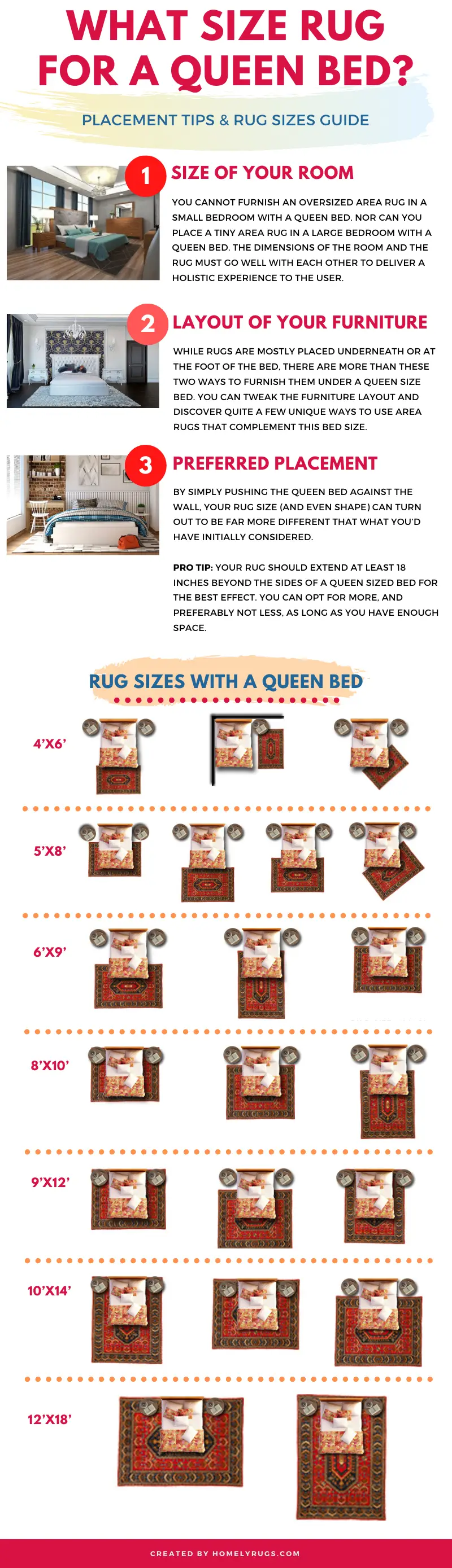
You cannot furnish an oversized area rug in a small bedroom with a queen bed. Nor can you place a tiny area rug in a large bedroom with a queen bed. The dimensions of the room and the rug must go well with each other to deliver a holistic experience to the user.

The layout of your furniture

The second factor that plays a major role in selecting an area rug size for the queen bed is actually the layout of the room.

While rugs are mostly placed underneath or at the foot of the bed, there are more than these two ways to furnish them under a queen size bed. You can tweak the furniture layout and discover quite a few unique ways to use area rugs that complement this bed size.

Your preferred rug placement for a queen bed

The placement of a rug in correspondence to a queen size bed is also something that needs to be considered when selecting the best size. By simply pushing the queen bed against the wall, your rug size (and even shape) can turn out to be far more different that what you'd have initially considered.

For the best rug placement for a queen bed, your rug should extend at least 18 inches beyond the sides of the bed. You can opt for more, and preferably not less, as long as you have enough space.

Area Rug Size Chart for Queen Beds

Here's a standard rug size chart and a brief look at how each size and work best with a queen size bed:

Dimensions in Feet Dimensions in Centimeters Best uses and features
3'x5' 91 x 152cm This is the smallest sized rug that you can pair with a queen sized bed. Just put it at the foot of the bed and leave a small strip of bare floor along all the edges.
4'x6' 121 x 182 cm This is the smallest rug size that you can pair with your queen bed. It's usually aligned with the footboard and can be used to design a floor sitting area when furnished with a compact chaise lounge, a couple of ottomans, or even just a bunch of floor cushions.
5'x7' 152 x 213cm There's only 1' of difference between 5'x8' rug and this one. Just put it at the foot of the bed and it will look absolutely perfect.
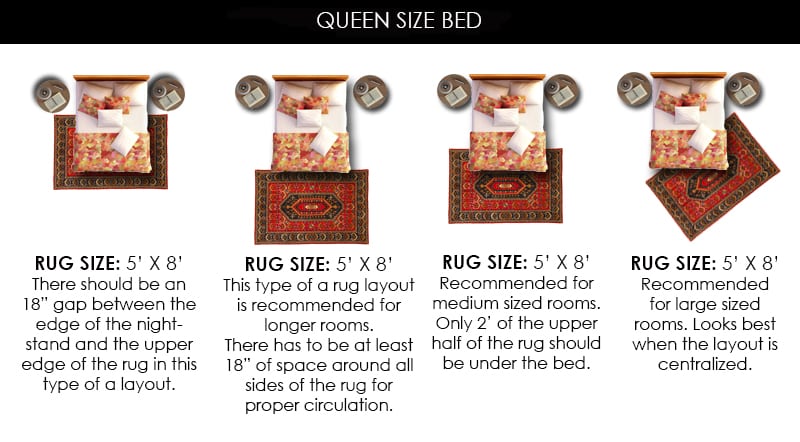
5'x8' 152 x 243 cm The length of this rug size perfectly aligns with the size of a queen bed's footboard. You cannot really furnish its edges under the bed. They must align with the footboard and have at least 2 feet of circulation space up front. So this rug looks the best when it's placed in a large room. You can accent it with floor cushions, a decorative trunk, a chaise lounge or a bunch of ottomans.
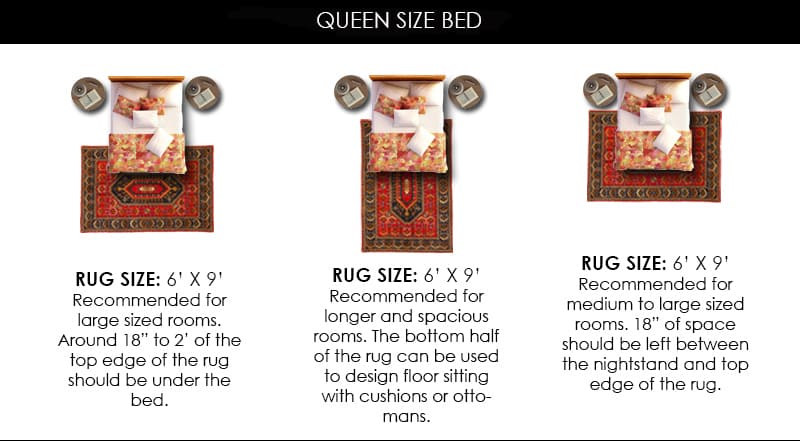
6'x9' 182 x 274 cm You can furnish this rug size in a way that at least 18" or more of it are hidden under the bed. You'll have 1' of the rug edge visible on each side. It's best that you not accent this rug size with anything, or it will look too overwhelming.
7'x9' or 7'x10' 213 x 274 cm or 213 x 304cm Very similar in size, both of these rugs can pair well with a queen sized bed. Just place the top 18" to 24" (or more depending on the size of your room) of the rug underneath the footboard while the rest can be embellished with floor cushions and ottomans.
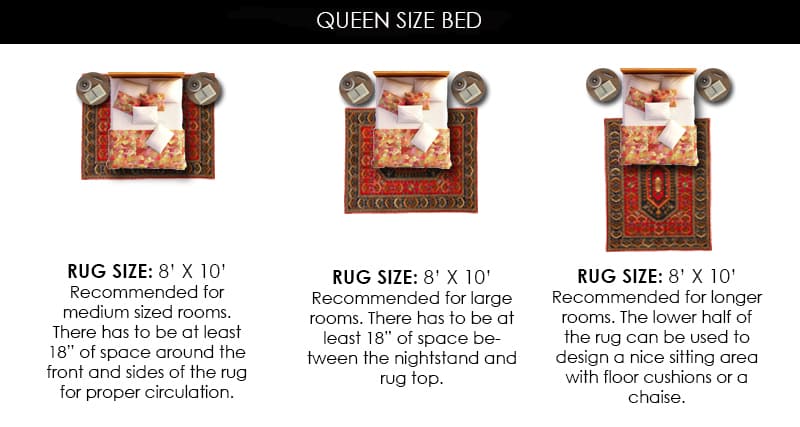
8'x10' 243 x 304 cm With this rug size, you'll have almost 18" of rug edges visible on each side. You can furnish it so that at least one quarter of the rug width lies under the bed. Once again, it's not recommended to furnish it with any accent furniture or accessories.
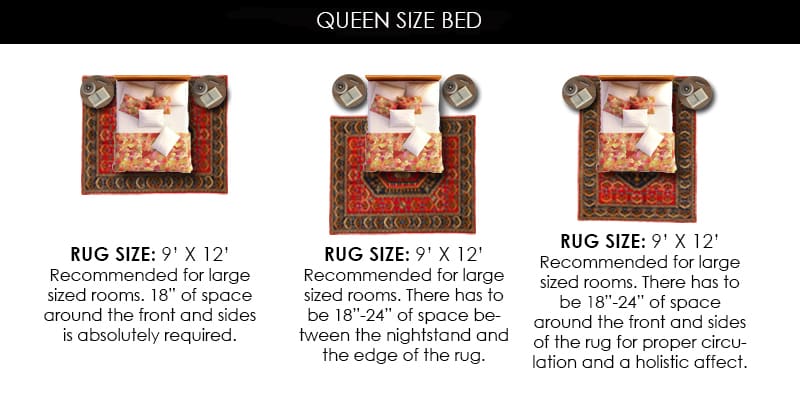
9'x12' 274 x 365 cm This rug size is recommended for larger bedrooms. 2 feet of the edges will be visible on each side, so half the rug should be under the bed.
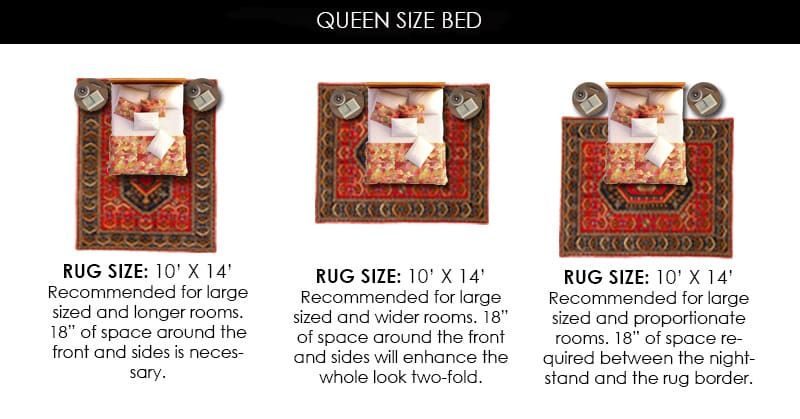
10'x14' 304 x 426 cm This rug size looks best in large bedrooms. When perfectly centered, almost 2.5' of the rug edges are visible from each side. The best placement is when there is an 18" gap between the nightstand and the edge of the rug that is under the bed.
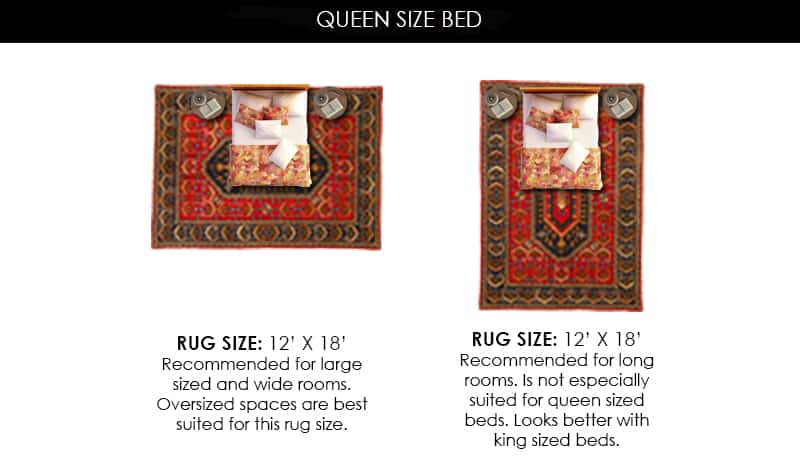
12'x18' 365 x 548 cm This is the largest area rug size that you can place under a queen bed. The whole bed can be placed under the rug and you'll still have left-over edges on all 2 sides.

Rug Sizes Under a Queen Bed

Here are some examples on how each rug size can be featured under or beside the queen bed (afterwards, see our infographic at the end of the article for a quick and easy comparison between all popular sizes):

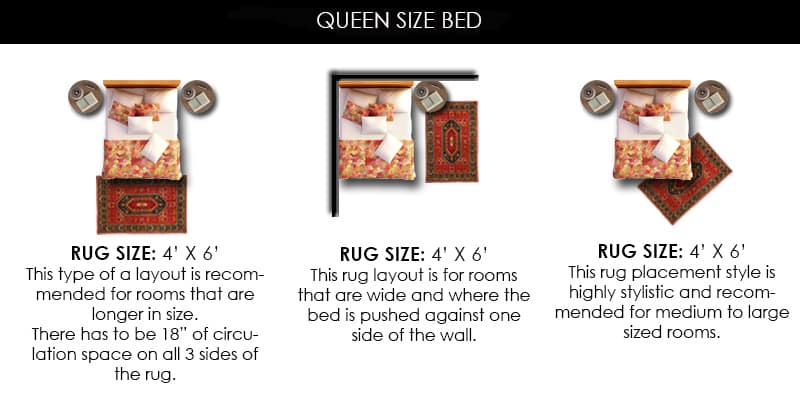
4' x 6' Rug Under Queen Bed

A 4'x6′ is a small sized rug which is perfect for anchoring small and medium sized bedrooms. However, if you're looking for the best layout, then a four feet by six feet rug will go well with a queen sized bed if you place it directly in front of the footboard.

But if you want to be stylistic, then you can place the rug at an angle underneath one end of the bed. Both ideas work for small and medium sized bedrooms wonderfully!

Here are some ideas to match them together:

4'x6' Rug Under Queen Bed

5' x 8' Rug Under Queen Bed

There are a number of ways to feature a 5'x8′ rug with a queen bed, but the best look is when the top 18" to 24" of the rug is placed under the footboard. This gives the whole layout a more cohesive look and makes the bedroom look absolutely pulled together!

Note that this five feet by eight feet rug is well suited for medium and large sized bedrooms that need a focal point to anchor the ambiance.

You'll love how this rug size will complement medium to large sized rooms. Here are some layout ideas for you to get started:

5x8 Rug Under Queen Bed Layout

6' x 9' Rug Under Queen Bed

Compared to the dimensions of a queen bed, a 6'x9′ rug is rather large. Therefore, it's suited for medium to oversized bedrooms that have a lot of space in front of the bed.

There are quite a number of ways to pair it with this bed size. In our opinion, however, the best and most wholesome way to match a queen bed with a six feet by nine feet rug is by putting the majority of the rug underneath the bed, only leaving 18" to 24" of bare floor between the nightstands and the top of the rug. This will help make even a medium sized room feel bigger and more pulled together!

Here are some ideas to pair them together:

6'x9' Rug Under Queen Bed

8' x 10' Rug Under Queen Bed

An 8'x10′ rug size is preferred for large rooms as its big span can make a medium sized room feel rather cluttered.

The entirety of the eight feet by ten feet rug can be put underneath a queen sized bed, but the best option is if you leave around 18" to 24" of space between the rug top and the nightstands. This gives the whole layout a rather cohesive look!

There are a number of ways that this rug size can be matched with a queen bed. Here are some popular choices for layouting:

8'x10' Rug Under Queen Bed

9' x 12' Rug Under Queen Bed

Depending on the size of your room, a 9'x12′ rug can either be placed fully underneath the queen bed or you can leave an 18" gap between the rug top and the nightstands.

A 9 feet by 12 feet rug is categorized as 'large' and thus is only recommended for oversized rooms. If featured in a mid-sized bedroom, it can make the space feel quite cluttered.

Here are 3 popular ways that you can pair the bed and the rug with one another:

9'x12' Rug Under Queen Bed

10' x 14' Rug Under Queen Bed

The most proportionate way to pair a queen sized bed with a 10'x14′ rug is to place the whole bed and nightstands on top of the rug.

If your room is extra-large, then you can leave a 24" gap between the top of the rug and the nightstands. This type of rug layout looks pulled together and wholesome when there's at least 24" to 36" (or more) of bare floor area around all visible rug edges.

A ten feet by fourteen feet rug is great for pairing with queen beds. It's the right amount of large and complements the size of a standard queen size bed perfectly. Here are some popular layouts you can take inspiration from:

10'x14' Rug Under Queen Bed

12' x 18' Rug Under Queen Bed

A 12'x18′ is an extremely large rug size, especially compared to the scale of the queen bed.

The best way to proportionately pair its twelve feet by eighteen feet body with the queen bed is to place the whole bedroom furniture set (including the bed, nightstands, footboard ottoman/chaise, etc.) set up on top of it.

However, this rug size is not typically recommended for queen beds. It's too large and looks disproportional against the size of the bed. But if you still want to go ahead, here are two good ways to use it – given that you have a large bedroom:

12'x18' Rug Under Queen Bed

Round Area Rug Placement with Queen Size Beds

There are four popular round rug sizes and there are a number of ways that you can pair each one with a queen size bed. Let's take a look at all of them:

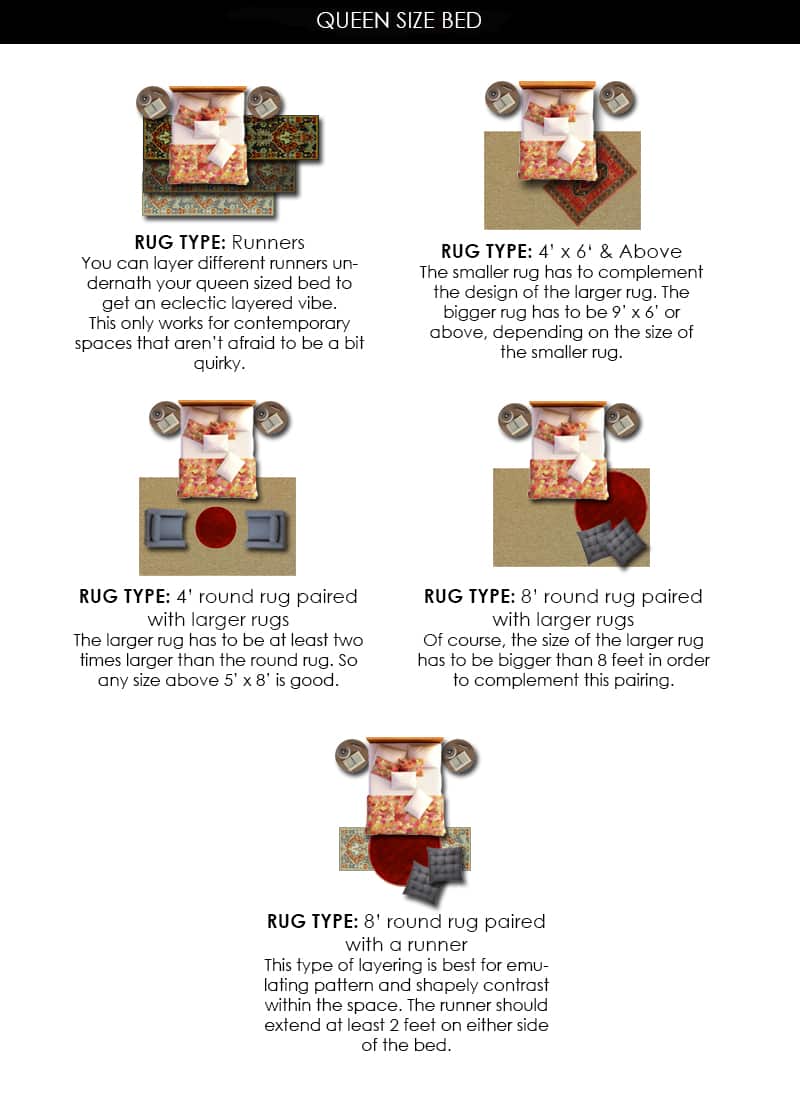
4' Round Rug Under Queen Bed

A 4' round area rug is perfect for featuring in small to medium sized rooms. It's great for designing an accent reading nook in a large bedroom as well. Here are some unique ways to match this rug with a queen bed:

4' Round Rug Under Queen Bed

6' Round Rug Under Queen Bed

A 6' round rug is medium sized and is great for featuring in small to medium sized rooms. Here are some layout ideas that you can use to pair this rug size with a queen bed:

6' Round Rug Under Queen Bed

8' Round Rug Under Queen Bed

An 8' round rug is neither too big, nor too small so it's perfect for medium to large sized bedrooms. Here's how you can pair it with your queen sized bed:

8' Round Rug Under Queen Bed

12' Round Rug Under Queen Bed

This is the largest round rug size and only looks good in oversized bedrooms. Here are the best ways that you can feature this rug size with your queen bed:

12' Round Rug Under Queen Bed

Runner Placement with Queen Size Beds

Runners are typically used in hallways and transitional areas, but they can also be featured in a bedroom. Their elongated shape is suited for medium and large sized bedrooms. An average runner is between 2 feet to 3 feet wide.

The length of the runner is more diverse and you can find one that lies anywhere between 5 feet to 14 feet. You can pick a runner size that complements the size of your bedroom. Here are some ideas to pair runners with your queen size bed:

Runner Placement with Queen Size Bed Layout

Rug Layering Ideas with Queen Size Beds

Rug layering is recommended for only large sized bedrooms. In smaller spaces, layering tends to look very cluttered and makes the room feel visually overwhelming.

One thumb rule to remember during this venture is that the base rug should always be lighter in color so that the top rug can stand out more. Usually khaki natural fiber rugs are used as the base, as they're inherently understated and sturdy to begin with.

Here are a few ideas that you can use to introduce layering with area rugs in your home interiors:

Rug Layering Ideas with Queen Size Bed Layout

See more:

  • General Rug Size Guide for all Rooms
  • Rug Size for a King Bed

So, this is everything that you need to know about pairing different types of rugs with a queen size bed. We hope this guide helps you make the best choice, let us know which size you went for!

What Size Rug for Queen Bed Infographic
Please share & Pin it 🙂

8 X 12 Bedroom Layout

Source: https://homelyrugs.com/rug-size-under-queen-bed/

Share:

Small Bedroom For Two Brothers

Small Bedroom For Two Brothers

Some kids share a bedroom even when they don't have to. Here's what experts and families have to say about the pros and cons—and how to make it work.

As kids, my twin sister and I had our own separate bedrooms in our spacious suburban house—hers was carpeted in '80s bubble gum pink, mine in royal blue—but we still slept in the same bed every night. Our parents say we had slept better in the same crib, too. My twin would roll over and hold my bottle up to my lips when we were only a few months old. As toddlers, we'd babble in gibberish after lights out. Throughout our childhood, we continued to stay up late together, chattering and curling up under the covers

When my daughters were born—two girls who are just 22 months apart—having them share a bedroom made sense. To begin with, we had no other choice in a two-bedroom house. And how wonderful would it be for them to be as close as my sister and I are to this day? We moved them in together when the youngest was one and the oldest was almost three.

The whole idea of having a separate bedroom for each kid is a relatively recent middle- and upper-class phenomenon in North America, where there are, on average, fewer than two children per household, yet the houses are among the biggest in the world. But look at different cultures and countries where housing costs are higher and space more limited, and sharing rooms—and even beds—is just a given.

Of course, there are pros and cons to both set-ups. While some of us will do whatever it takes to give kids their own rooms for the sake of more privacy and longer stretches of sleep, others are deciding to have them share even when there is space. Spare rooms are being used for guests, offices and play areas, and families are seeing the benefits of kids learning to negotiate and bond with their siblings.

We asked Laura Markham, the author ofPeaceful Parent, Happy Siblings: How to Stop the Fighting and Raise Friends for Life, and Pam Edwards, a paediatric sleep consultant, about the upsides and downsides of making sharing a room work for your family.

Who's bunking with whom

Some families don't have a choice, but others do. What if you have more than two kids, or children with a big age gap, or different genders or personalities? While there's no right answer, here are some issues to consider.

Age

In theory, siblings of any age could share a room, but a good time to make the move is when the younger kid is sleeping through the night, so as not to disturb the other child, says Edwards, who runs Wee Bee Dreaming Pediatric Sleep Consulting in Kamloops, BC. If you have more than two children, their ages might also factor in to how you divide them.

Angela Lecompte lives with her husband and their three girls, ages 11, eight and five, in a typical three-bedroom semi-detached house in Toronto. Lecompte originally had the two older children sharing a room (which is what Edwards usually recommends), but now that her eldest daughter wants more privacy, she's switched it so the two younger girls are sharing instead.

"For my older daughter, having space now is important. She started puberty and needs her own space and time away from her little sisters, who bug her at times. But we do remind her regularly that she's the only one in the house with her own bedroom." Lecompte says it'll be interesting to see how things play out when her middle child starts demanding privacy too, but for now, it's working. "They ask me regularly when they'll get their own rooms," she says. "Um, never?"

Personality

Siblings on the same bed. 5 things to think about before moving your baby into an older sibling's bedroom If you have the luxury of another option, parents shouldn't push a child who doesn't seem ready to share a room into the new arrangement, says Markham, a clinical psychologist who specializes in children and parents, and is based in New York City. But some siblings are naturally very caring and keen to welcome a younger brother or sister into their space. Markham herself is significantly older than her siblings, but growing up, she had to share her room. "When I was six, my sister was born, and when I was 12, my brother was born," she says. "I was very nurturing with both of them—my brother even slept in my room when I was 12, and I ended up liking it." But of course, the opposite could be true. "You can also imagine a 12-year-old who is really lost in their own world and would not want to be bothered by their little brother….I think a lot depends on the relationship between the kids."

Gender

When it comes to sharing a room, gender identity might not be relevant for younger kids, but once children are between ages eight and 10, they may no longer be comfortable changing in front of each other. For that matter, even kids who identify as the same gender want more privacy as tweens, so Markham recommends being sensitive to that and doing what you can to give them more space.

The upside

The dream scenario for some families with more kids than available bedrooms is that they all get along and happily share a room. That's because there are loads of benefits—the friendship, resilience and problem solving, not to mention the extra space it would allow for other things or even more children (if that's a wish).

"All kids are different, so it's whatever works for your family, but often, kids really love sharing a room once they're used to it," says Markham. "And the reason they love it is because they get closer. They have a soulmate they can spill their secrets to after lights out," she says. "I have families who put their kids on a double mattress. And the kids love it, because then they're next to a warm body and they fall asleep better. That way, they don't wake up scared in the middle of the night—there's always their sibling to snuggle up with."

Nicole Jepsen, a mom of two who lives in Cambridge, Ont., has had her six-year-old son and three-year-old daughter share a room since the youngest was 10 months old. Even after moving from a three-bedroom house in Toronto to a four-bedroom home 90 minutes southwest of the city, she plans to keep them rooming together until she hears any complaints. "I get a lot of flack because of them being opposite genders, but I don't see it as a big deal," she says. "They sleep better together, and it's my (maybe unpopular) opinion that we, as adults, prefer to sleep with a companion in the room, so why wouldn't we allow the same for our kiddos?" Jepsen even got them a bunk bed with a double mattress on the bottom because they sometimes like to share a bed.

Having kids share a room might feel more secure for parents, too. Helena Stones, a mother of five in Victoria, BC, has all of her kids sleep in the same room even though they live in a four-bedroom house. The children's ages range from two to nine, but because there are two bedrooms upstairs and two downstairs, Stones and her husband feel more comfortable with the kids on the same floor as them. (They came to this conclusion out of necessity—when the eldest was six, he left his bedroom, then in the basement, and walked out of the house in the middle of the night.) They have fit a triple bunk bed, a toddler bed and a crib into the one room. Storage is tight, so they have fewer clothes and do lots of laundry, and toys are kept elsewhere. "The bedroom becomes a jungle gym—the idea of sharing is really celebrated around the kids, so they see it as a positive thing," says Stones. "The kids love it. They want us to have more babies, but I tell them the next one is going to be a grandkid."

Potential problems

Of course, sharing a room is not all sunshine and sweet cuddling sessions. Sibling dynamics can be tricky to navigate and add more chaos to life with kids. What if they have different bedtimes? Won't they wake each other up in the middle of the night? Will they have more trouble falling asleep? Or what if they just hate sharing a room?

Sometimes my daughters take turns singing each other to sleep, and it melts my heart. But the other half of the time, lights out is challenging. My five-year-old is often desperate to fall asleep after a long day at kindergarten, but she struggles to tune out the shenanigans of her three-year-old sister, who isn't as tired because she still naps for two hours at daycare.

"It can be tricky if their sleep schedules are different," says Edwards. For instance, if one of your kids is loud or cries a lot, even if you think the other one is used to it and doesn't fully wake up, the quality of their sleep is lowered, which can be detrimental long term. So you may have to work on that and consider sleep training. Personality differences and sibling rivalry are also some of the toughest issues to overcome, adds Markham. If the relationship is problematic and two siblings just don't get along, sharing a room doesn't tend to help the situation.

How to make it work

So how can you make the most out of sharing a room, while negotiating boundaries and solving disputes?

Time it right.

If you have an older child who's not adjusting well to a baby and already feels like they have to share everything—such as your love and time—you may want to hold off, says Markham. If you're having a third child and planning on putting the older two children together, do it before the baby arrives so there's less resentment about the new addition to the family.

Don't use sharing to solve sleep problems.

For a child who has regular nighttime wakings, it could be a comfort to have a roommate or bed buddy, but Edwards says it likely won't help existing sleep problems and may introduce new ones. Kids should learn how to self-soothe and sleep independently. "I would never recommend room sharing with the intention of trying to solve sleep problems," says Edwards. "I would try to tackle that first and use room sharing as a reward for good sleep and not a solution for poor sleep."

Create personal spaces.

Every kid needs privacy sometimes, but introverts especially crave it. "A lot of introvert kids really need this. They get their energy from being alone," says Markham. "And if they're always in the middle of a family and they always have a sibling around, they're never alone to recharge their batteries." In lieu of their own room, you could get a bed tent or canopy, or, for older kids, a large bookcase in the middle of the room might help divide the space. Designate special areas for each child's belongings and give older kids a secure spot, like a box with a lock on it, to keep their treasures away from prying little hands.

Turn up the volume.

White noise is great for winding kids down and blocking out distracting sounds, but my younger daughter doesn't like it. She also talks to herself before falling asleep, which drives my older daughter bananas. In cases like these, Markham suggests playing relaxing music or an audio story, so kids can focus on that instead of their own voices to self-soothe. That's what we've been doing and it's working for both girls.

Get bunk beds.

Bunk beds are popular because they not only save space but also visually separate kids for sleep, so they're less likely to bother each other. Just make sure the child sleeping on the top bunk is at least six years old and that the bed being used meets current safety standards. Always use the ladder to get on and off the top, and only play on the bottom bunk if the lower space is designed by the manufacturer as a play area.

Make the room a quiet zone.

Reserving the room for quiet activities, including reading and homework, is a good way to manage arguments about how the space is used. All the noisy stuff, including playdates, should happen in common areas of the house, like the living room.

Manage conflicts.

If kids don't learn to solve disputes when they're young, they're never going to get it right as grown-ups. "Children certainly aren't born knowing how to do this, so we need to teach them," says Markham. While you don't want to take sides between siblings, you should still help them work out a disagreement, paying attention as soon as it starts, she says. One tip is to draw up a list of rules that you can point to and enforce. Writing things down goes a long way, even if your kids don't read yet, Markham says. Some good ones for the list are "We are a family, and we always work things out," "No mean voices or yelling" and "We always clean up our own messes."

Think about sleep times.

If your kids are close in age and have similar sleep needs, do bedtime routines and stories together. Give older kids a short time limit to chat once they're in bed. Otherwise, bedtimes should be separated by at least one hour, says Edwards. That timing might seem like more work, but it could be a solution to those bedtime struggles. For example, you may need to let a toddler who still naps during the day stay up later than a school-aged kid, says Edwards.

Separate them for naps.

It's hard to get two kids sharing a room to settle down at the end of a tiring day, and it's even harder for afternoon naps. If both kids need to sleep and space allows for it, consider moving the older one to another room or to your own bed (a.k.a. "the big bed"), suggests Edwards (if your eldest is old enough to stay in an adult bed safely). It will be easier for both of them to wind down.

Be patient.

Expect a transition period of three to six weeks to adjust to rooming together, and be patient, says Edwards. "This is normal—don't give up if it's not working right away."

Read more:
6 tips to help keep the peace between siblings
Kid's rooms: cute ideas for every age

Small Bedroom For Two Brothers

Source: https://www.todaysparent.com/family/parenting/tips-for-siblings-sharing-a-bedroom/

Share:

Waterfall Lights For Bedroom

Waterfall Lights For Bedroom

Bedrooms are busy places. Sure, we use them to sleep in – but they're also places where we relax and where we read, where we spend time with our partners, where we get glammed up for going out, suited up for social whirls and in or out of our everyday clothes. That means before you dive in and start ordering from our best bedside lamps, it's worth taking a moment to consider exactly what you need and how it might work in the space.

The best bedroom lighting is a mix of mood lighting and lighting for getting things done: lights to get dressed to, or lights to apply make-up in front of, or lights to create an atmosphere. So how do you get lights to do all that? We have some suggestions…

  • Need your lighting to do more? The best wake-up lamps will help promote a healthy sleep-wake cycle
  • Browse the best cheap Hue bulb deals live now
  • You'll find more inspiration in our bedroom lighting ideas

Do: think soft

There are three key types of light: natural light, which comes in the windows; task lighting, which is for a job – reading, doing makeup, making sure you look good before you go out – and mood lighting, which creates atmosphere. The most effective lighting for making bedrooms look inviting is soft, mood lighting.

Don't: use harsh spotlights

Spotlights are designed to be very bright and very focused, so if you're going to use them in your bedroom make sure they're dimmable. Too many bright spotlights makes a room feel like a shop.

Do: start with the bed

In most bedrooms the bed is the single most dominant feature, so it's sensible to start there: you might bracket it with bedside table lamps or wall lights, or do something interesting with the headboard.

Bed with bedside lamp

(Image credit: Christopher Jolly on Unsplash)

Don't: forget about LED strips

LED strips are much more flexible than standard lights, so for example you can use them behind or along furniture, on the beams of high ceilings, inside cupboards, behind the headboard or anywhere else you want to add some illumination.

Do: think about lighting zones

Chances are you use different bits of your bedroom for different things, so if you're an avid bedtime reader you'll need slightly different bedside lighting than if you're just going for decorative lights; if you like to do make-up at a dressing table you'll want suitable illumination so you don't overdo the blusher.

Don't: use cool white LEDs

LED bulbs typically come in two flavours: white, sometimes called cool white, and warm white. The former is cooler, more wintry and more blue, while the latter has the yellowish warmth of candles and incandescent bulbs.

Do: think about colour-changing bulbs

Whether it's bulbs or strips, colour-changing smart bulbs can be absolutely brilliant in bedrooms: you can create colour recipes and control them from your smartphone or smart speaker, so you might have one recipe for relaxing, another for tidying and yet another for spooning. We really rate the Philips Hue system, but there are good options from the likes of Hive and Lifx too – head to our best smart bulbs guide for a full run-down, or see how the two leading brands match up in our Philips Hue vs Lifx comparison. Just steer clear of the eBay cheapies, which have a distinct school-disco vibe.

Philips Hue Iris lamp

(Image credit: Philips)

Don't: confuse your styles

What style does your bedroom have? Is it traditional? Retro? Achingly modern? Futuristic? Pick lighting that complements the furniture and decoration: mixing incompatible styles can look distinctly odd.

Do: think bigger

If you're thinking about smart bulbs for the bedroom and you haven't already chosen an ecosystem, think about what you might like to add to the rest of the house too. That way you can be sure that if you want to add more lighting elsewhere, you're not stuck with a system that can't do what you want. For example, if you go down the IKEA route with its TRADFRI lights there are some nice lamps as well as a good range of bulbs, but there aren't any outdoor options or coloured LED strips for behind the TV; if you go for Hue, on the other hand, there's a massive range of smart bulbs for every conceivable fitting as well as lots of nice lamps and outdoor lights, but they're often quite expensive.

It's worth thinking about your existing non-smart lights too: for around £10 you can add a smart bulb that'll connect any light to your smart home and enable you to control it from your app or smart speaker.

Don't: forget about the darkness

It sounds obvious, we know, but are you planning your lighting in the room during the daytime? If you are, you're seeing the room in a completely different way than it looks at night. Areas that benefit from great natural light during the day could be much darker once the sun's gone down.

Do: make use of mirrors

Mirrors aren't just for confirming that you're gorgeous. They're also brilliant at maximising the available light. Thoughtfully placed mirrors can make a dark bedroom feel much bigger, reflecting both natural and artificial light throughout the space.

Bed with a mirror on the wall behind

(Image credit: Andrea Davis on Unsplash)

Don't: keep wardrobe lights locked inside

If your wardrobes are mirrored, don't put your lights inside them: if you have down-facing lights on the outside of the wardrobe the mirrors will reflect it into the room while still lighting up your stuff when the doors are open.

Do: think about layers

There are three distinct parts of your room to light: the ceiling, the walls and the floor. Try different types of lighting for each, so for example you might have a subtle wash of light on the walls but something brighter above you; if you tend to bump into things in the night some motion-sensing, floor-level lighting could save your toes.

Don't: keep yourself in the dark

Think about what you'll be doing, so for example if you're going to use the wardrobe mirrors to see how you look before you go out it's important to have lights in front of you, not behind you: if you don't, you'll find it hard to discern colours and detail. If you use make-up, do the same with your make-up mirror: you should have a light source pointing at your face, not the back of your head.

Do: use multiple bulbs

You'll get a much nicer effect with several low-intensity bulbs or a string of little LEDs than with one bulb that's so bright you can see your own skeleton.

Don't: go crazy with lamps

Lamps are great things, but only in moderation: if you've already got a lamp on either side of the bed and one or two lamps elsewhere in the room, that's a good place to stop. You don't want your room to look like the lighting department of B&Q.

Lots of hanging lamps

(Image credit: Etienne Girardet on Unsplash)

Do: think about the details

If you have shelves, pictures or open-faced storage you can use lighting to highlight them and add interesting accents to the room.

Don't: put downlighters over the bed

Downlighters can be lovely, but they're best for indirect lighting so put them around the room rather than directly over the bed. You don't want to wake up with a GU10 bulb blazing directly into your eyeballs.

Do: test-drive your design

Don't just imagine the lights in your mind's eye. Go to the places you'll be doing things and imagine yourself doing them. Is your bedside reading lamp going to annoy your partner? Would your intended wall lights put light in the right places?

Carrie Marshall

Writer, musician and broadcaster Carrie Marshall has been covering technology since 1998 and is particularly interested in how tech can help us live our best lives. Her CV is a who's who of magazines, newspapers, websites and radio programmes ranging from T3, Techradar and MacFormat to the BBC, Sunday Post and People's Friend. Carrie has written thirteen books, ghost-wrote two more and co-wrote another seven books and a Radio 2 documentary series. When she's not scribbling, she's the singer in Glaswegian rock band HAVR (havrmusic.com).

Waterfall Lights For Bedroom

Source: https://www.t3.com/us/features/tips-and-tricks-for-bedroom-lighting

Share:

Best Bedroom Colors To Sell A House

Best Bedroom Colors To Sell A House

How Do You Choose a Paint Color for Your Bedroom?

Photo Courtesy: Karen Moskowitz/The Image Bank/Getty Images

Ready to deck out your bedroom with an entirely new look? Creating the perfect vision for your sleep space is exciting and fun — once you get past the challenging first step of choosing a new paint color. Achieving the look and feel you want for your primary relaxation zone all starts with selecting the perfect color for your walls.

Do you want the room to inspire a bright, cheerful mood or promote a sense of calm? The color you choose can help you achieve it. Are you interested in lavish furnishings and decor or pieces with simple tones and lines? Your walls need to complement your desired look, not clash with it. Your final choice comes down to personal taste, but we can offer some insight to help you create the bedroom of your (sweet) dreams.

Pick Your Favorite Colors

Start by thinking about colors you really like and heading to your nearest hardware or home improvement store to pick up some paint samples that catch your eye in those color groups. Be sure to choose samples in both light and dark tones for each color. Regardless of the emotions and themes associated with different colors, you want the color you choose to be one you like. Don't waste time looking at samples you don't find visually appealing, and don't get caught up in trends that focus on a color you don't actually like.

Photo Courtesy: Experienceinteriors/E+/Getty Images

You are the one who spends time in your bedroom, and you want to enjoy the experience. Do you find neutral colors like white, gray and brown to be boring and dull? Then don't choose those colors for your walls just because they are universal and easy to match to furnishings and bedding. Are you drawn to pastel colors or rich jewel tones? Or do you love bright, vibrant colors? You instinctively know what you like, and that is your starting point for narrowing down the list of possible colors.

Give Some Thought to Color Psychology

After you collect samples of the paint colors you like best, think about the mood (feeling) you want to promote inside your bedroom. The concept of color psychology focuses on the ways colors promote different emotions. For example, the warm hues on the color wheel — red, orange and yellow — tend to inspire more energetic feelings. Many people associate the color red with strong, passionate emotions like love, lust and anger, while orange dials the energy back a bit to create a sense of bravery and confidence but with a little less daring. Not surprisingly, yellow promotes happy, positive, "sunshiney" feelings.

Photo Courtesy: laughingmango/E+/Getty Images

In contrast, cool hues on the color wheel — blue, green and purple — often promote soothing, relaxing emotions. Blues are typically associated with feelings of calmness and serenity because of their association with the sky and the ocean — those bodies take on dark gray or black tones when they aren't calm during storms — and greens often bring to mind freshness and renewal because of their association with plants and growth. Purples inspire a hint of mystery and have a centuries-old connection to royalty, luxury and even the occult.

Keep in mind that in some cases, negative expressions in society cause some people to feel negatively about colors that usually promote positive feelings. For example, you may associate the color blue with feelings of sadness rather than calm tranquility, thanks to depression-related expressions of "feeling blue." Similarly, the tendency of some people to refer to cowards as "yellow" may make you think of caution and cowardice when you see the color yellow instead of happiness. Variations in shade can also change how colors make you feel. A bright blue probably won't feel as soothing as a light sky blue, and a soft baby pink won't feel aggressive and bold like a dark red.

Of course, not everyone wants color on their walls, instead preferring to stick to neutral paint tones in shades of brown, white or black. Shades of tan and brown bring to mind feelings of dependability and coziness and are common choices for more reserved personality types. White creates a crisp, clean look and sparks feelings of purity, while black generally creates a negative vibe, except when it's used as a powerful, elegant accent color. As a blend of white and black, gray is a popular paint choice that depicts the harmony of the two. Color psychology offers some insight into the common relationships between colors and emotions, but your own feelings about a particular color will always matter more than any general guidelines.

Think About the Mood You Want to Create

As you ponder the emotions associated with different colors and eliminate paint options, think about the mood you want to create in your bedroom. If you're not sure how to answer that question, then consider how you will normally use the room. Do you expect to only spend time in your bedroom when you enter to go to bed at night? Then the mood inspired by your color choice may be less relevant, and you can simply focus on complementing your chosen bedding and decor.

Photo Courtesy: asbe/E+/Getty Images

However, if you plan to relax in your bedroom in the evening curled up with a good book or the remote control, then you may want to gravitate to more relaxing cool tones like lighter blues, greens and purples to encourage your body to release tension and wind down. Do you expect to spend more time in your bedroom in the bright light of morning, sitting next to a sunny window while you sip your coffee and watch the morning news? Then warm, energizing colors in the red, orange or yellow families may be just what you need to help you feel revitalized and ready to face the day.

Color Coordinate with Your Adjoining Rooms

If you're still having trouble making a decision, then you can always resort to basic interior decorating tactics and color coordinate your adjoining rooms. For example, if your bedroom has an adjoining master bathroom that is painted a pretty shade of pink, then you could think about colors for your bedroom that would complement the pink. That could mean painting your bedroom another matching shade of pink or opting for a complementary color on the color wheel, which you can find online. (For the pink example, colors in the green family would be complementary.)

Photo Courtesy: Jon Lovette/DigitalVision/Getty Images

Use an Online Paint Color Viewer

Many paint manufacturers have fun and useful tools on their websites that allow you to upload a photo of your room and "paint" the walls with different colors of your choice. The tools are usually easy to use and allow you to see in an instant if you like a particular color or if it's darker or lighter than you thought based on the sample. However, it's important to keep in mind that you need to use high-quality, well-lit photos of your rooms to ensure the most accurate results. Paint colors could look dramatically different if the lighting in your photo is poor. Most companies also provide a variety of stock images to practice with, and it's generally a good idea to compare the look of the paint on your photo with that of a stock photo.

Photo Courtesy: pepmiba/E+/Getty Images

More From QuestionsAnswered.net

Best Bedroom Colors To Sell A House

Source: https://www.questionsanswered.net/lifestyle/how-choose-paint-color-your-bedroom?utm_content=params%3Ao%3D740012%26ad%3DdirN%26qo%3DserpIndex

Share:
banner